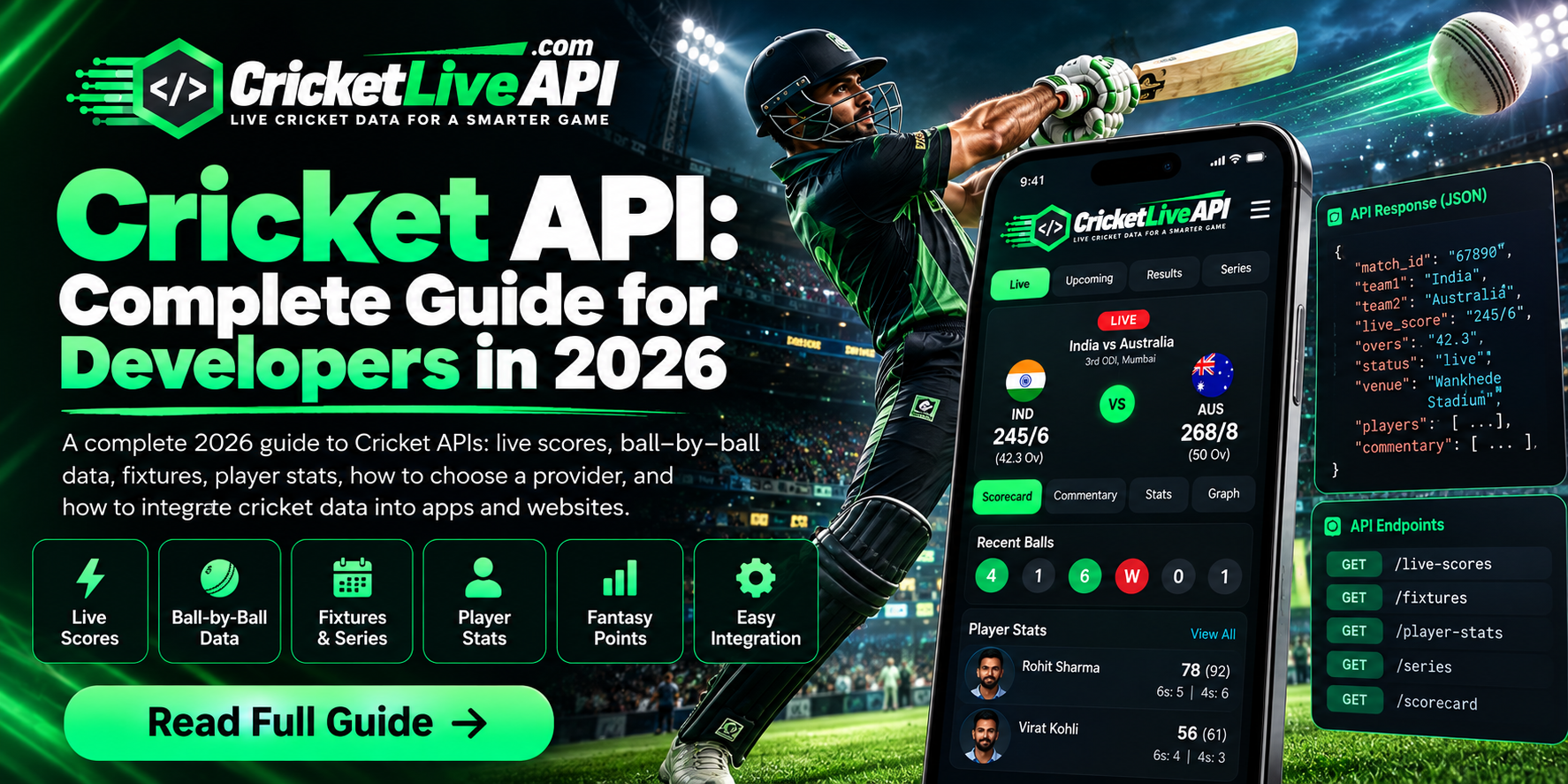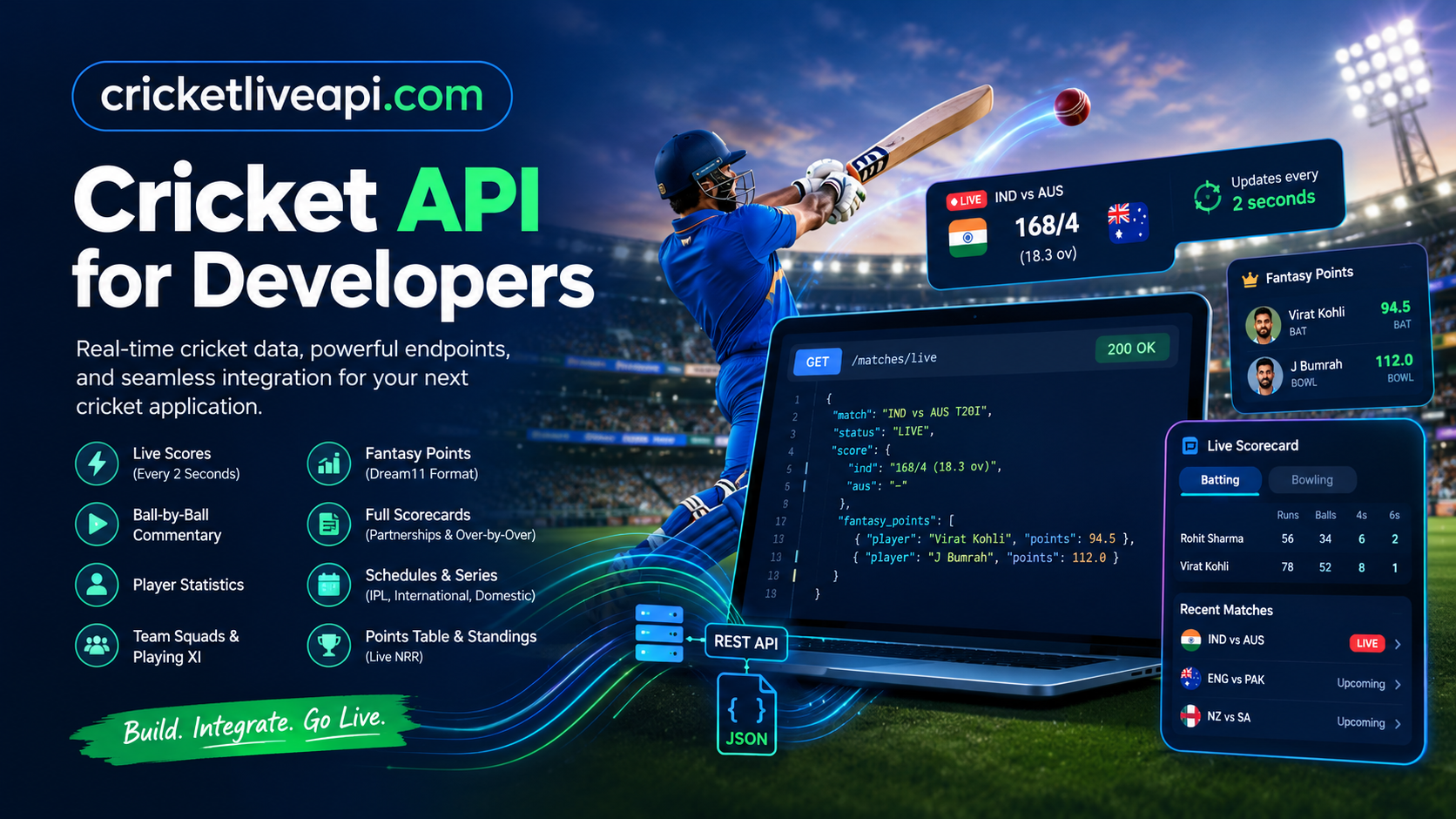
Cricket API for Developers: Live Scores, Fantasy & Cricket Data
Build powerful cricket applications with real-time cricket data. Learn how a Cricket API can provide live scores, ball-by-ball commentary, scorecards, player statistics, fantasy points, playing XI, schedules, and tournament standings through developer-friendly JSON APIs.
Cricket API for Developers: How to Build Live Cricket Apps with Real-Time Data
Building a cricket website or application is relatively straightforward. The difficult part is keeping the application supplied with reliable, structured and continuously updated cricket data.
A modern cricket app may need much more than a final score. Developers often need live scores, ball-by-ball commentary, complete scorecards, player statistics, playing XI information, schedules, points tables and fantasy points. Collecting and maintaining all of this data independently can quickly become a complicated backend project.
A Cricket API solves this problem by providing structured cricket information that applications can request programmatically. Instead of manually collecting scores or maintaining a large cricket-data database, developers can connect their application to an API and work with JSON responses.
For developers building cricket score apps, fantasy platforms, sports dashboards or notification systems, this approach can significantly simplify development.
What Is a Cricket API?
A Cricket API is an application programming interface that gives software access to structured cricket data.
A typical application sends an HTTP request to an API endpoint. The API processes the request and returns information in a machine-readable format such as JSON.
For example, a live-score application might request information about currently running matches and receive data containing:
- Teams
- Match format
- Current score
- Overs
- Run rate
- Match status
- Recent ball information
- Player information
- Fantasy points
The application can then transform that JSON data into its own user interface.
This separation is important. The API handles the cricket-data layer, while the developer can concentrate on the product experience.
Why Developers Need a Live Cricket Data API
Cricket is a continuously changing sport. During a live match, the score can change after almost every delivery.
If a developer is building a live cricket application, outdated data can make the entire product feel unreliable. A good live cricket score API therefore needs to provide timely updates while returning data in a format that developers can easily consume.
A cricket data API can help applications display:
- Live match scores
- Ball-by-ball events
- Batting and bowling scorecards
- Player statistics
- Playing XI and squad information
- Match schedules
- Series information
- Points tables and standings
- Fantasy cricket points
- Player and team images
This creates a reusable data layer that can support multiple products instead of building a separate data pipeline for every application.
Live Cricket Scores and Ball-by-Ball Data
Live scoring is one of the most common reasons developers integrate a Cricket API.
A live-score application may need to show the current innings, score, overs, run rate and latest match events. For a better user experience, the application can also display ball-by-ball information.
CricketLiveApi provides live cricket data with updates designed for real-time applications. Its website states that live scores and ball-by-ball information are updated every two seconds.
This type of update frequency is useful for products such as:
- Cricket score websites
- Mobile cricket apps
- Live score widgets
- Match dashboards
- Sports notification systems
- Cricket analytics platforms
Instead of building the complete scoring infrastructure yourself, your application can consume structured data and decide how that information should be presented.
Fantasy Cricket API Data
Fantasy cricket applications require another layer of information beyond the basic match score.
A fantasy product may need to track runs, wickets, catches, player participation and other match events before converting them into fantasy points.
A Fantasy Cricket API can simplify this process by providing calculated player points alongside relevant match information.
For example, a fantasy application could receive data similar to:
{
  "match": "IND vs AUS T20I",
  "fantasy_points": [
    {
      "player": "Virat Kohli",
      "points": 94.5,
      "runs": 78
    },
    {
      "player": "J Bumrah",
      "points": 112.0,
      "wickets": 3
    }
  ]
}
The frontend can then use this information to create live leaderboards, player cards or fantasy dashboards.
For developers, the major advantage is that the application does not have to build the entire scoring calculation system from scratch.
Cricket Scorecards and Match Details
A live score alone is often not enough.
Users may want to know how individual players performed, who took wickets, how partnerships developed and what happened throughout an innings.
A detailed cricket API can provide structured scorecard information including:
- Batting figures
- Bowling figures
- Partnerships
- Fall of wickets
- Overs
- Runs
- Wickets
- Player performance
This makes the API useful for applications that want to build complete match pages rather than displaying only a headline score.
For example, a developer could use the scorecard endpoint to create a custom match page while keeping the website's design completely independent from the underlying data provider.
Player Statistics and Performance Data
Player data is another important component of a cricket application.
A useful player-data system can include career statistics, recent form, batting averages, bowling averages and performance information across different formats and venues.
Developers can use this information to build:
- Player profile pages
- Cricket analytics dashboards
- Fantasy selection tools
- Performance comparison features
- Historical statistics pages
This is particularly valuable for fantasy platforms because users often want more context before selecting players.
Recent form, venue performance and historical statistics can become separate features inside the same application.
Playing XI, Squads and Match Selection
Playing XI information can be especially important for fantasy cricket applications.
Before a match begins, users may want to know which players are actually included in the playing team.
A cricket API that provides squad and Playing XI information allows developers to display this information directly inside their own product.
The same data can be used to build player-selection interfaces, match previews and fantasy team-selection workflows.
Schedules, Series and Points Tables
Cricket applications also need information outside the live match itself.
A complete cricket data platform may need to provide:
- Upcoming matches
- Series information
- Match dates
- Venues
- Toss information
- Tournament standings
- Points tables
- Net run rate
- International and domestic competitions
These features help developers build complete cricket products instead of a simple live-score page.
For example, a cricket application can combine a schedule endpoint with live-match data. Upcoming matches can appear on one screen, while currently active matches can automatically move into a live-score section.
What Makes an API Developer-Friendly?
When choosing a Cricket API, developers should evaluate more than the number of endpoints.
1. Data Freshness
Live applications require frequently updated data. Check how quickly scores, commentary and player information are refreshed.
2. API Response Speed
Fast responses help applications deliver a smoother experience, particularly during high-traffic matches.
3. Simple Authentication
Developers should be able to authenticate requests without unnecessary complexity.
4. Structured JSON
Predictable JSON responses make it easier to integrate the API with JavaScript, Python, PHP, Java, mobile applications and other technologies.
5. Coverage
Check whether the API covers the competitions your application needs, including international cricket, IPL and domestic tournaments.
6. Rate Limits
Understand the number of requests allowed per minute and per day before selecting a plan.
7. Scalability
A prototype may require only a small number of requests. A production application with thousands or millions of users will require substantially more capacity.
8. Documentation and Support
Good documentation reduces integration time and makes troubleshooting easier.
How CricketLiveApi Fits Into a Modern Cricket Application
CricketLiveApi is designed as a REST-based cricket data platform for developers. Its website lists data endpoints covering live matches, scorecards, fantasy points, player statistics and points tables. It also highlights JSON responses, fast response times and reliability for cricket applications.
The platform can be used for several types of products, including:
- Cricket score applications
- Fantasy cricket platforms
- Sports analytics tools
- Cricket websites
- Match-alert systems
- Notification bots
- Gaming applications
- Sports dashboards
The key advantage of using an API-based architecture is flexibility. Developers can create their own frontend, database workflows and user experience while using the API as the cricket-data layer.
A Simple Integration Workflow
A typical cricket application can follow a straightforward architecture:
User
  ↓
Web / Mobile Application
  ↓
Your Backend
  ↓
Cricket API
  ↓
Structured Cricket Data
  ↓
Your Application UI
The frontend does not need to know how cricket data is collected or processed.
Your backend can request the required information, validate the response and deliver only the data required by the application.
This architecture also makes it easier to add features later.
Live Scores
     +
Scorecards
     +
Player Stats
     +
Playing XI
     +
Fantasy Points
     ↓
Complete Cricket Application
Instead of developing each data system independently, developers can build product features around a common cricket-data source.
Choosing the Right Cricket API for Your Project
There is no single API configuration that is perfect for every application.
A developer building a small cricket blog may only require schedules and basic scores.
A fantasy cricket startup may need live points, player statistics, Playing XI and match information.
A sports analytics platform may require historical data, scorecards and detailed player statistics.
Before integrating any provider, define the actual data requirements of your application.
A practical checklist is:
Data requirements → API coverage → update frequency → response speed → rate limits → pricing → documentation → scalability
This prevents developers from selecting an API based only on its headline feature.
Start With a Small Integration
You do not need to build an entire cricket platform before testing a Cricket API.
Start with one feature, such as a live-score page.
Once the basic integration works, add scorecards, player statistics, schedules, commentary and fantasy data according to your application's requirements.
CricketLiveApi provides a free tier for developers who want to start testing the platform. The available plans can be reviewed on the website before scaling your application.
This type of staged approach lets developers validate the API integration before scaling the application.
Final Thoughts
A modern cricket application needs more than a static score.
Live scores, ball-by-ball events, scorecards, player statistics, Playing XI information, schedules, standings and fantasy points can all contribute to a richer product experience.
A Cricket API provides the underlying data layer that allows developers to build these features without maintaining every cricket-data process themselves.
For developers building cricket apps, fantasy platforms, sports dashboards or analytics products, the right API can reduce development complexity and make it easier to focus on the product itself.
If your project needs structured live cricket data, start by identifying the endpoints and update frequency you actually require, then test the integration with a small feature before scaling.
CricketLiveApi provides a developer-focused REST API for live scores, cricket data, fantasy points, player statistics and related match information.