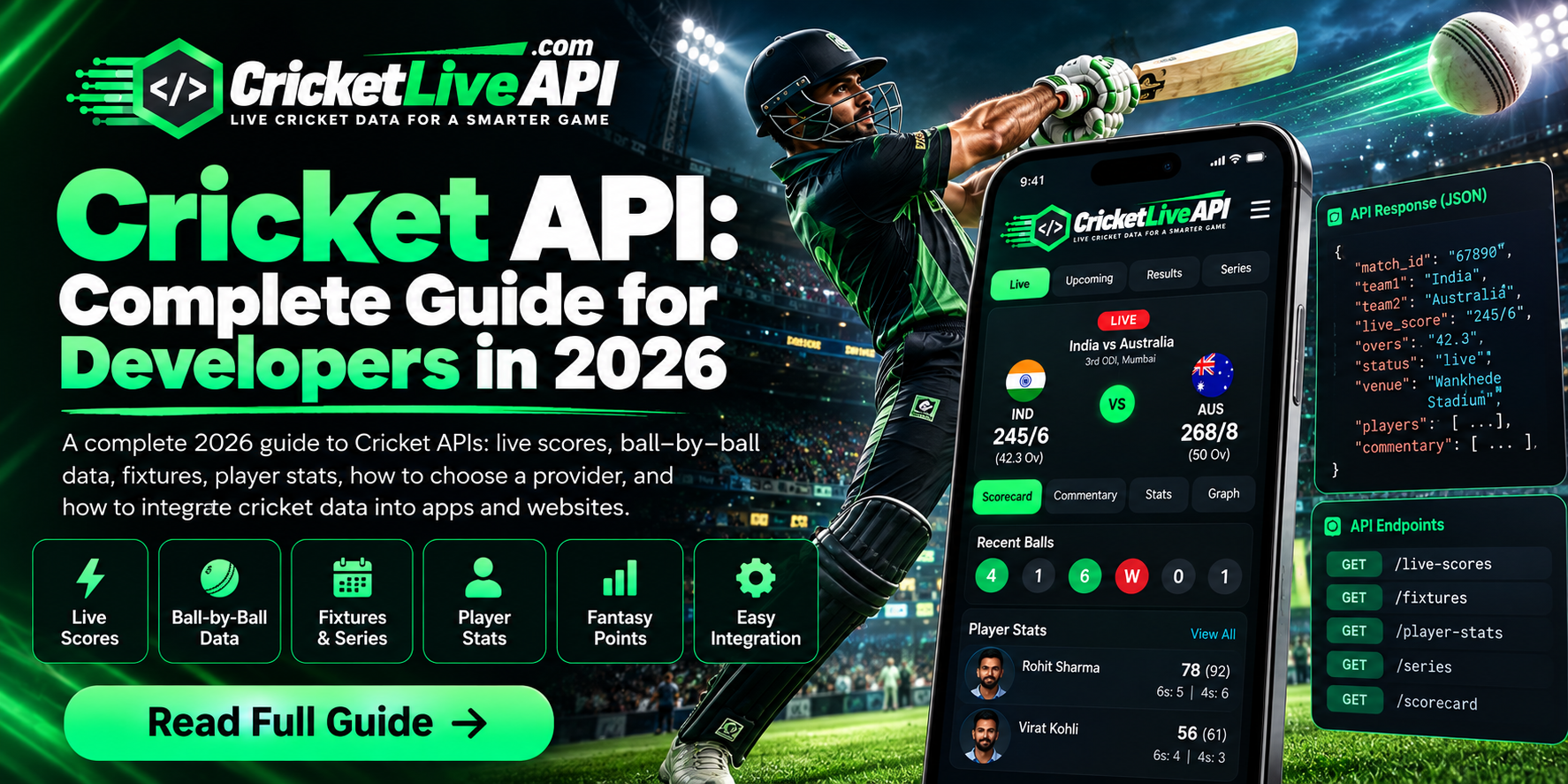
Cricket API: Complete Guide for Developers in 2026
A practical 2026 guide to Cricket APIs: what they return, how to choose a provider, and how to wire live scores, fixtures, and player stats into an app or website.
A Cricket API lets your app request live scores, fixtures, results, and player stats as JSON instead of collecting that data by hand. This guide covers what a Cricket API returns, how the request flow works, how to choose a provider, and how to connect it to Android, web, and fantasy products in 2026.
You will leave this page knowing which data you actually need, how to compare providers, and which related guides to open next for live line, fantasy, and website builds.
Keep reading on CricketLiveApi
What Is a Cricket API?
A Cricket API is an HTTP interface that returns structured cricket data. Your backend sends a request and gets JSON back, so the app does not have to scrape scorecards or maintain its own data pipeline.
A live-score screen usually needs:
- Team names and current score
- Overs, wickets, and run rate
- Current batsmen and bowlers
- Match status, commentary, and recent deliveries
The same feed can power a website, an Android or iOS app, a fantasy platform, or an internal dashboard. If you are comparing vendors first, start with how to choose a Cricket API provider.
How Does a Cricket API Work?
Your app → API request → Cricket API → JSON → your UI.
A live-match request looks like this:
GET /api/v1/matches/live{
"status": true,
"data": [
{
"match_id": "12345",
"team_a": "India",
"team_b": "Australia",
"score": "185/4",
"overs": "18.2",
"status": "Live"
}
]
}Endpoints, auth, rate limits, and field names change by provider. Read those before you design your own response shape. For a production site, cache this response instead of calling it once per visitor. The live score website guide shows that pattern.
What Data Can You Get?
A useful Cricket API covers more than the current score. Match the fields below to the product you are building.
1. Live scores
Score, overs, wickets, run rate, target, required rate, partnership, batsmen, and bowlers. This is the core of a live-score app. For ball-speed specifically, see the India live line API guide.
2. Ball-by-ball data
Over, ball, runs, extras, wicket, batsman, bowler, commentary, and dismissal. Use this for live line apps and delivery-level analytics.
3. Fixtures
Upcoming matches, calendars, tournament schedules, team schedules, and alerts.
4. Results
Completed matches for results pages, team history, tournament archives, and news apps.
5. Player statistics
Matches, runs, wickets, batting average, strike rate, economy, bowling average, catches, and profiles. Fantasy and analytics products depend on this set. The fantasy cricket API guide goes deeper on points and playing data.
6. Teams, series, and tournaments
Team name, id, squad, logo, country, rankings, recent matches, plus international series, domestic tournaments, T20 leagues, ODIs, Tests, and World Cups.
Why Developers Use a Cricket API
Collecting, cleaning, and refreshing cricket data yourself means servers, retries, and match-day failures. An API moves that work to the provider so you can build the product.
- Faster build: request data instead of running your own collection stack.
- Structured JSON: the same payload can feed backend and frontend.
- Live updates: scores move with each request, or from your cache.
- Room to grow: raise the plan when traffic grows, without a new integration.
- One source: scores, fixtures, players, teams, and results from one provider.
How to Choose a Cricket API
Price is the last check, not the first. Confirm the provider can support the competitions and traffic you expect. A fuller checklist is in choosing a provider for scores, stats, and fantasy. Teams shipping in India should also read the India provider comparison.
Coverage
Confirm internationals, domestic cricket, T20 leagues, player stats, and ball-by-ball if your app needs them. Do not assume every plan includes every series.
Speed
A live-score app feels broken if the score is minutes behind the broadcast. Ask how often live data is refreshed.
Reliability and docs
Check uptime, monitoring, and docs for auth, endpoints, parameters, examples, errors, and rate limits. Weak docs cost more than a cheaper plan saves.
Limits and pricing
A prototype can live on a small monthly quota. A public site needs a higher cap, caching, and support. Compare requests, live access, history, stats, coverage, and rate limits together.
Where You Can Use It
Android
Android app → your backend → Cricket API. Keep the API key on the server. The backend can cache, reshape, and limit requests before Kotlin or Java (often Retrofit) renders the screen.
Websites
Website → backend → Cricket API → cache → page. Serve one cached response to many visitors. That cuts cost and keeps the page fast during a live match. Follow the website build guide if that is the product.
Fantasy
Fantasy apps usually need fixtures, squads, player stats, playing XI, live scores, match status, and ball-by-ball data. Check the fantasy live line guide before you lock a plan. Your app still has to follow local law, store policies, and the rules of the contest you run.
Cricket API vs Scraping
| Feature | Cricket API | Web scraping |
|---|---|---|
| Structured data | Yes | Depends on the page |
| Integration | HTTP + JSON | Custom parser |
| Consistency | Stable contract | Changes with the site |
| Maintenance | Provider handles the source | You fix the scraper |
| Layout changes | Usually safe | Can break overnight |
| Docs | Expected | None |
| Scale | Built for API traffic | Extra servers and proxies |
For a production app, a documented API is easier to keep online than a scraper tied to someone else's HTML.
Common Products
- Live score sites: score, status, commentary, fixtures.
- Mobile apps: the same data on Android or iOS.
- Fantasy: players, squads, stats, and live match state.
- Analytics: player, team, and historical match data.
- News sites: match pages and tournament hubs next to articles.
- Scoreboards: venue screens and internal dashboards.
Why Look at CricketLiveApi
CricketLiveApi is built for developers who need cricket data in an app or website: live scores, stats, fixtures, and player data behind an API key. Before you pick a plan, read the current docs, endpoints, limits, and pricing.
Compare any provider, including this one, on reliability, freshness, coverage, docs, auth, limits, price, support, and scale. If you want a shorter buying guide, use this provider checklist and the India-focused write-up.
Start in Seven Steps
- Pick a provider from the data and traffic you need.
- Create an account and choose a plan.
- Copy the API key or other auth credential.
- Read the docs for endpoints, params, responses, and limits.
- Call one endpoint such as fixtures, teams, or live matches.
- Connect your backend and render the JSON in your UI.
- Add cache and errors before real users arrive: cache, retries, logs, and clear API errors.
FAQ
What is a Cricket API?
It returns structured cricket data — scores, fixtures, results, players, and teams — for an app or website.
What can I build?
Live-score sites, Android and iOS apps, dashboards, analytics tools, and fantasy products.
Is there a free Cricket API?
Some providers offer a free or trial plan with a low request cap. Check the current limits before you launch.
Which API is best?
The one that matches your coverage, update speed, limits, price, docs, uptime, and support. There is no single winner for every app.
Can I use it in an Android app?
Yes. Put the key on your backend and let the app talk to that backend.
Can it serve live scores?
Yes, when the plan includes live data: score, overs, wickets, and match status.
Which languages work?
Any language that can send HTTP and read JSON, including PHP, Java, Kotlin, JavaScript, Python, and Node.js.
Conclusion
A Cricket API removes the hardest part of a cricket product: getting clean, current data. In 2026, choose on coverage, freshness, reliability, docs, limits, and support — not price alone.
Next, open the guide that matches your build: a live score website, fantasy cricket, or a live line app.